

K9 Division — Civilians who own, or are buying, a trained protection K9
Civilian Protection K9
From first-time owner to capable K9 team. You and your K9. One team. One mission.
Two ends of the leash. One standard.
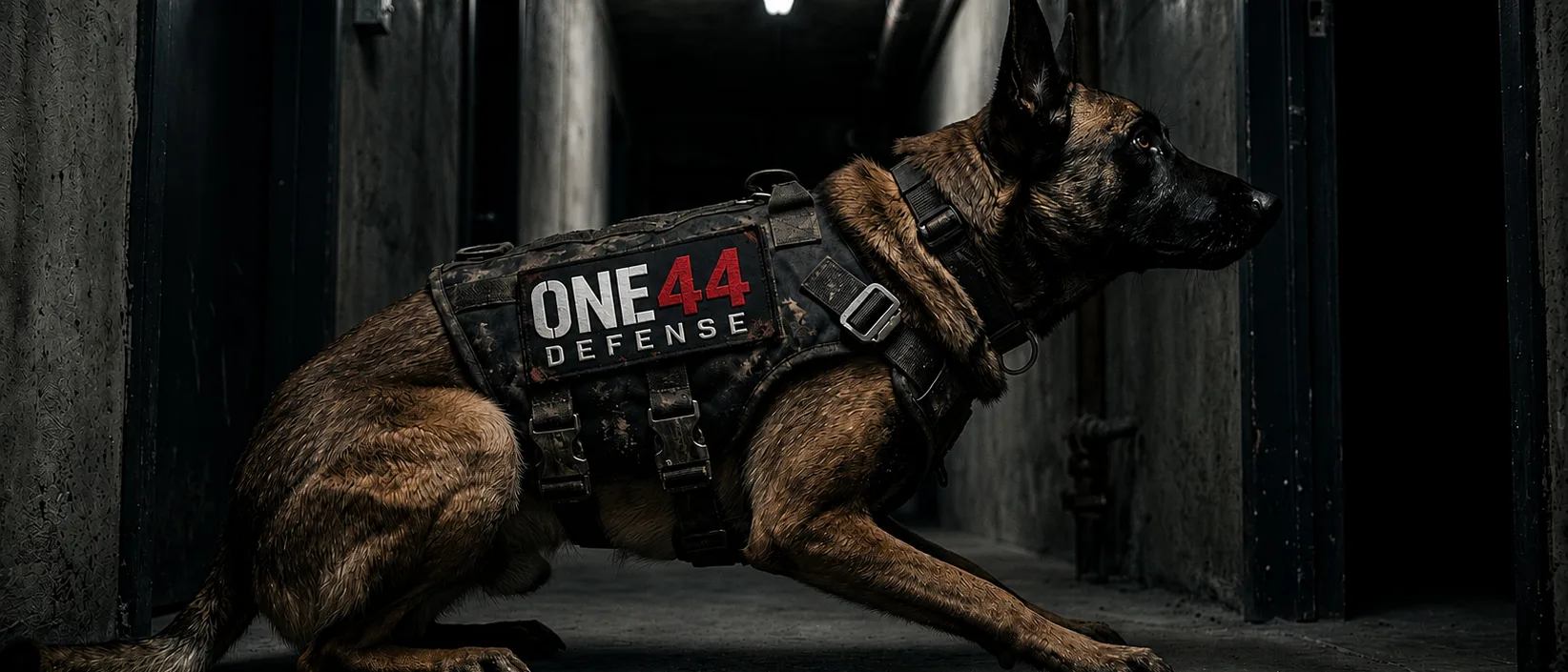
You don't need previous tactical experience.
You don't need to have handled working dogs.
You don't need to come from military or law enforcement.
You may simply be someone who has decided to bring a professionally trained protection K9 into your family—and understands that purchasing the dog is only the beginning.
A trained dog does not automatically create a trained team.
ONE44 Civilian Protection K9 teaches the person on the other end of the leash.
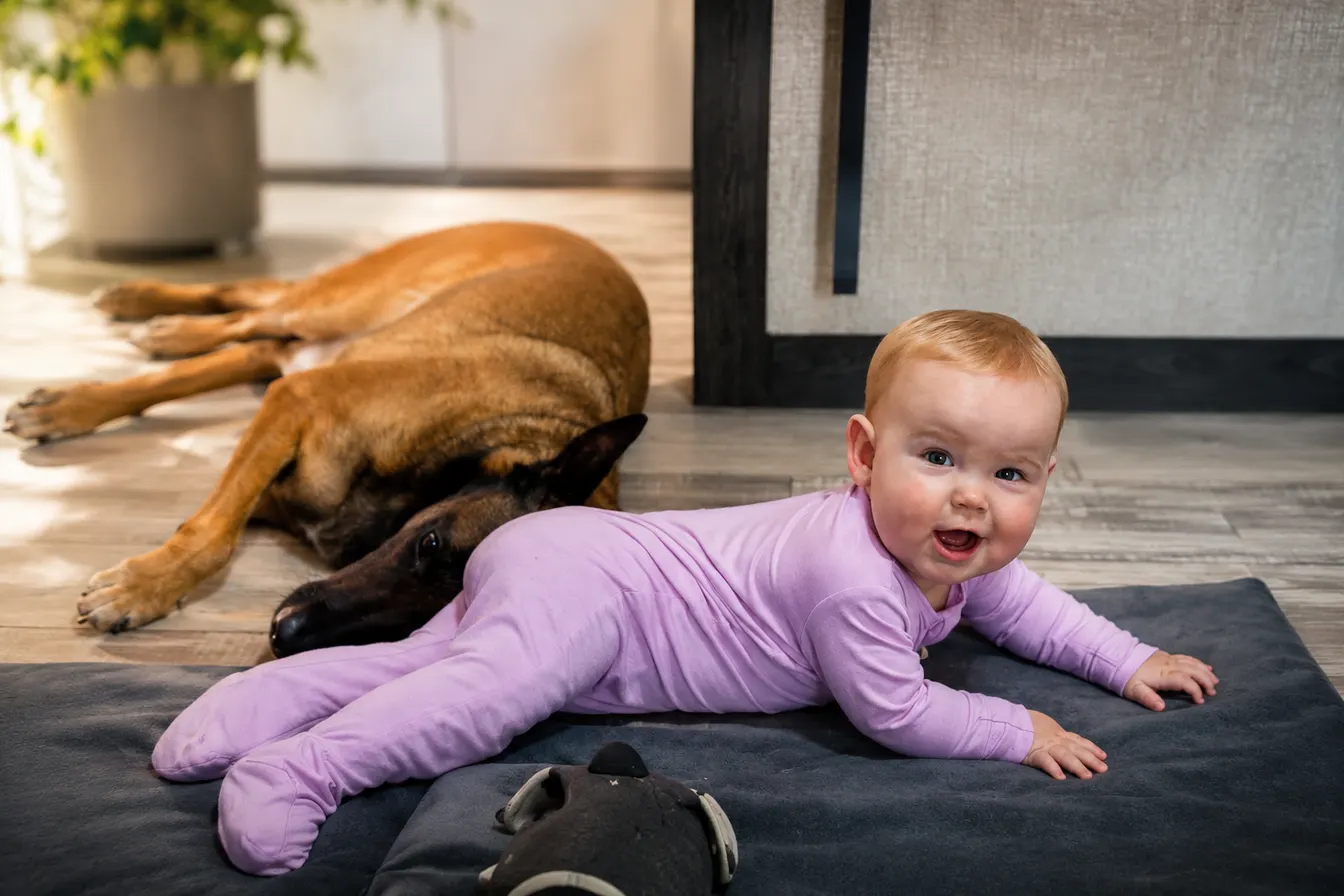
Starting from zero
This program is designed specifically to meet civilian handlers where they are. Before introducing stressful scenarios, students build the fundamentals required to safely own and operate with a protection K9.
Training begins with:
- Understanding working-dog behavior
- Building the handler/K9 relationship
- Commands and communication
- Leash mechanics and equipment
- Household structure and public behavior
- Reading canine body language
- Recognizing stress and charge
- Maintaining control around family and guests
- Children and K9 safety
- Veterinary and emergency planning
- Understanding the responsibilities of owning a protection dog
Living with a protection K9
This dog isn't stored in a safe until something goes wrong. It lives in your home. That means training must address ordinary life just as seriously as emergencies.
Students learn how to establish clear expectations, maintain obedience and control, safely introduce people into the home, manage children and visitors, travel with the K9, recognize behavioral changes, and maintain the dog's training throughout its working life.
A protection K9 should bring greater security to a household—not greater instability.
Home-invasion preparedness
A home invasion presents a completely different problem than training on an open field.
It is dark. Your family may be scattered throughout the house. Children may be asleep. Your K9 may recognize something before you do. You may have seconds to make decisions.
ONE44 teaches civilians to develop a family-centered emergency plan around their actual home. The priority is not hunting through the house looking for an intruder.
The priority is: recognize, communicate, protect, create distance, get your family to safety, call for help.
Students learn how the presence of a K9 changes movement, communication, positioning, family coordination, and emergency decision-making.
Operating with your K9 — unarmed
Students learn how to manage themselves and their K9 during a simulated critical incident without relying on a weapon. Training emphasizes:
- Maintaining control under stress
- Moving family members
- Using barriers and distance
- Communicating with the K9
- Moving through familiar environments safely
- Avoiding leash and equipment problems
- Identifying escape opportunities
- Protecting children
- Calling emergency services
- Regaining control following a highly charged event
Operating with your K9 — armed
For appropriately trained and legally armed adults, an advanced portion can address the additional responsibilities created when a firearm and K9 are present during the same emergency.
The emphasis is safety and decision-making, including maintaining positive control of the firearm, understanding where the K9 and family members are, preventing unsafe muzzle direction, avoiding crossfire problems, communicating while managing multiple responsibilities, and recognizing when introducing a firearm would create more danger rather than less.
This is not training civilians to pursue intruders or clear buildings. The objective remains protecting life and reaching safety.
Family integration
A K9 protection plan that only the handler understands is an incomplete plan. When appropriate, training can incorporate spouses and other household members so everyone understands:
- Emergency commands
- Where children should go
- Who calls 911
- Who controls the K9
- What happens if the primary handler is injured
- What happens if family members become separated
- How to behave while the K9 is highly charged
- How to interact with arriving law enforcement
- How the family reunites after evacuation
Scenario-based training
Once fundamentals are established, training progresses into controlled scenarios based around situations the civilian team could realistically encounter. Scenarios can include:
- Home invasion
- Unexpected person entering the property
- Nighttime disturbances
- Family evacuation
- Handler injury
- K9 injury
- Separation from children
- Public critical incidents
- Vehicle emergencies
- Transition from incident to arriving first responders
The standard
Buying an extraordinary dog doesn't automatically make you an extraordinary handler. That part has to be earned.
The dog has received hundreds or thousands of hours of development before entering your home. You owe your partner the same commitment.
Learn how your dog thinks. Learn how your dog communicates. Learn how to control yourself when your dog's intensity rises. Learn how to protect your family without creating another danger. Learn how to function together when the environment stops being comfortable.
Because when something happens at two o'clock in the morning, there isn't time to become the handler your dog needs.
You have to already be one.
Two bodies. Two nervous systems. One team.