

K9 Division — Handlers who bring their own working K9
K9 Tactical Operations
Operating with a K9 partner. Two bodies. Two nervous systems. One team.
Two ends of the leash. One standard.
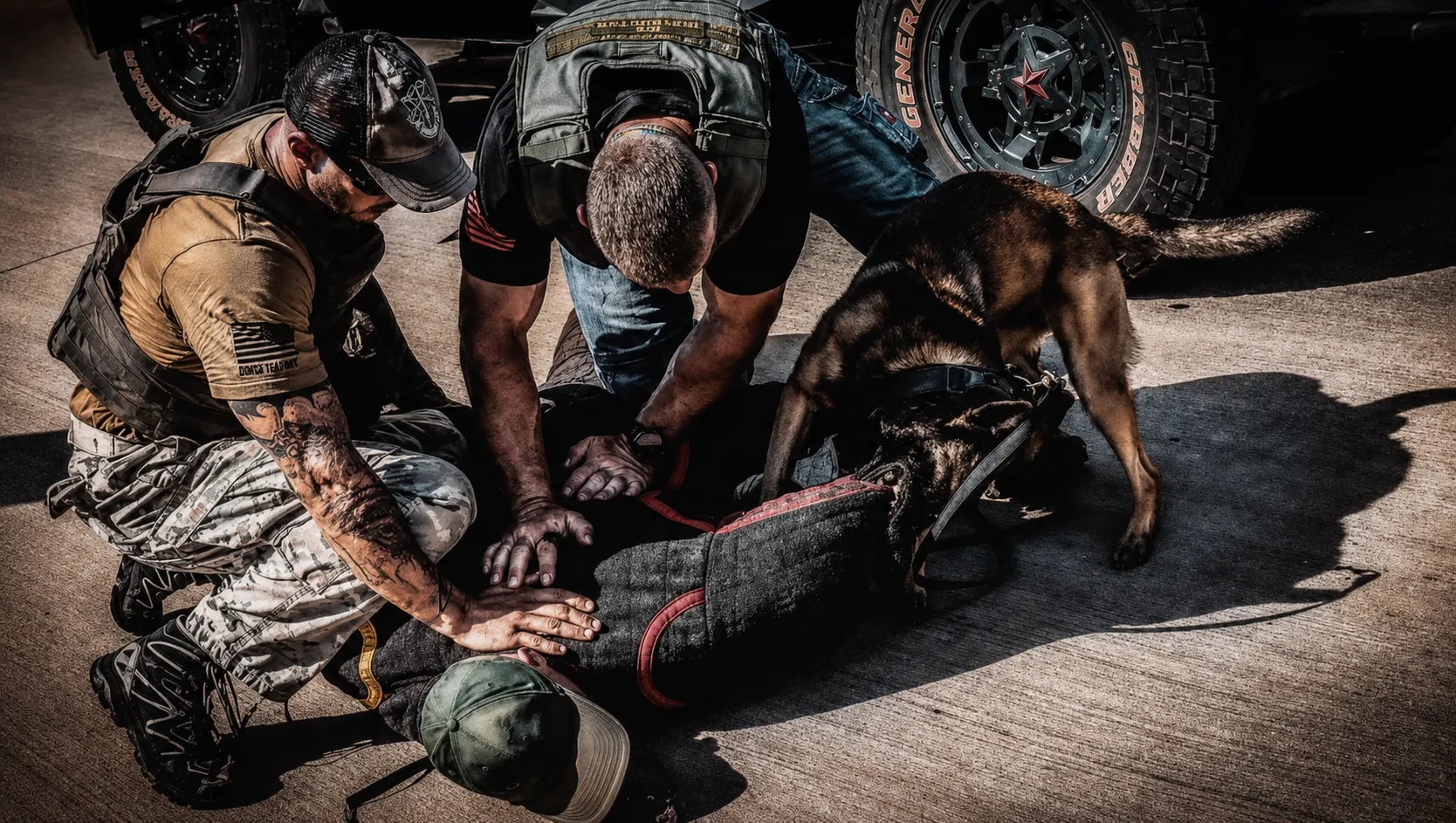
K9 Tactical Operations is a handler-focused program designed to teach people how to operate effectively with a working K9 partner.
This is not simply dog obedience, sport training, or a course about making a dog aggressive.
The focus is the human/K9 team.
Adding a working dog changes the way a person moves, communicates, observes the environment, manages equipment, makes decisions, and responds under stress. A capable individual can quickly become ineffective if they have never learned how to operate while responsible for another living member of the team.
ONE44 teaches handlers to understand that relationship and develop the skills necessary for two individuals to function as one working unit.
A K9 is not simply equipment at the end of a leash. It is a living partner processing the same environment through an entirely different sensory system.
The handler must learn to read the dog while simultaneously reading the environment. The dog feels tension through the leash, recognizes changes in movement and posture, detects environmental information the handler may never perceive, and responds to the handler's communication, confidence, hesitation, and stress.
The objective is therefore not simply controlling the dog. It is developing communication, awareness, movement, control, preparedness, and trust between both ends of the leash.
Bridging the gap
The gap between the K9 and the handler is the specialty this program was built around. Everything else comes out of that.
A working dog is a living, breathing partner. It carries stress. It can sustain PTSD. And it has no way to tell you — not the way a person can. That is what makes communication the whole job rather than a part of it.
Alicia Mills spent years working alongside law enforcement and military personnel, and traveled across the United States, Canada and Mexico teaching K9 tactics and speaking on this to officers, military personnel and civilians. What she kept finding was that very little of the available training actually applied to real-world scenarios. That left both ends of the leash exposed — the handler and the dog.
So she built a combat system around what actually happens, developed for the team rather than for the dog alone.
It started as a frustration. It became a passion. It is now the mission.
Understanding your K9 partner
Learn how working dogs process their environment, and how drive, charge, stress, environmental pressure, fixation, recovery, and handler behavior influence performance.
Students begin learning to recognize what their dog is communicating before automatically attempting to control or correct it.
Handler mechanics
Working with a K9 requires another level of physical coordination. Training develops:
- Leash management
- Body positioning
- Equipment management
- Maintaining usable hands
- Avoiding leash entanglement
- Direction changes
- Maintaining control while moving
- Transitioning between environments
Movement as a team
Handlers learn to move with their K9 rather than dragging, fighting, or constantly correcting the dog. Training can include:
- Walking and running
- Direction changes, stopping and starting
- Doorways, hallways and stairs
- Vehicles and obstacles
- Confined environments
- Working around other people
- Maintaining environmental awareness while controlling the K9
Communication
Clear communication becomes critical when stress increases. Students develop:
- Consistent commands and timing
- Leash communication
- Body-language awareness
- Communicating with teammates while managing the dog
- Preventing command overload
- Maintaining clarity under pressure
Environmental awareness
A handler cannot become so focused on the dog that they stop seeing everything else. Students learn to continually evaluate people, terrain, obstacles, vehicles, confined spaces, distractions, escape routes, environmental hazards, and changes in K9 behavior.
Sometimes the dog recognizes a change before the handler does. The handler needs to learn to listen.
Positioning and spatial awareness
Students learn to think about where the dog exists in relation to the handler, other team members, civilians, obstacles, entrances and exits, equipment, and environmental hazards.
A K9 team occupies space differently than an individual operator. Understanding that space prevents unnecessary problems before they happen.
Stress and decision-making
Stress affects both ends of the leash. Handlers learn how adrenaline, environmental pressure, uncertainty, and K9 charge can affect communication and decision-making.
Training progresses through controlled pressure so the handler learns to remain deliberate instead of simply reacting.
Deployment and recovery fundamentals
Students are introduced to the decision-making responsibilities surrounding a working K9. Not every problem requires the dog.
Handlers must understand when utilizing the K9 may be appropriate, when maintaining control is the better decision, and when disengagement is the smartest option available. Control after a highly charged event is equally important.
Working around other personnel
People working beside a K9 team also need education. Students learn how teammates should:
- Approach a working K9
- Communicate with the handler
- Move around the dog
- Avoid interfering with the leash
- Understand the handler's mobility limitations
- Respect the dog's working space
K9 emergency preparedness
Handlers should have a plan for when something goes wrong. Introductory training addresses:
- K9 medical preparedness and dedicated first-aid equipment
- Recognizing emergencies
- Evacuation planning and transport considerations
- Veterinary emergency planning
- What happens if the K9 is injured
- What happens if the handler becomes incapacitated
The ONE44 standard
The goal is not to produce a dog that looks intimidating. The goal is not to make the handler look tactical. The goal is competence.
A competent K9 team communicates without constantly fighting one another. They move deliberately. The handler understands the dog's behavior. The dog understands what is expected. Both can operate through environmental pressure without the relationship falling apart.
Because when circumstances become difficult, equipment cannot replace trust, and aggression cannot replace competence.
The leash connects more than the handler to the dog. It connects two nervous systems. Two sets of instincts. Two lives.
Train accordingly.